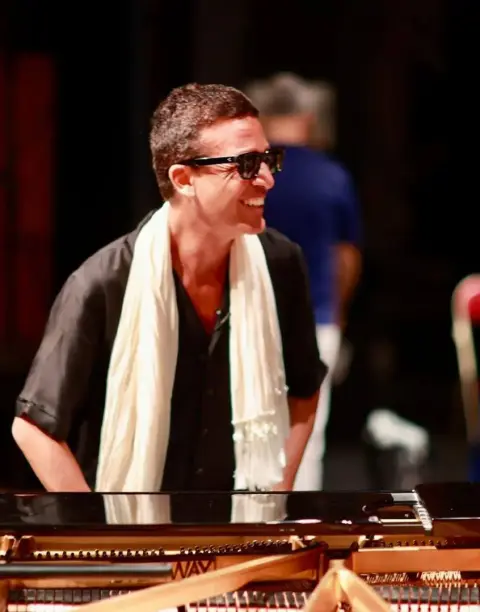
Nino Kirtadze left the post of representative of Georgia in the European Cinema Support Fund and European Film Promotion amid the noisy reorganization at the Georgian National Film Centre. While the obscure process that is perceived as a threat to the film sector is still ongoing, we discussed topics that have become the subject of judgment by various groups and talked about the current state and potential of Georgian cinema. Below is Forbes Georgia’s interview with Nino Kirtadze.
Before discussing Georgian cinema, could you tell us a bit about the European Cinema Support Fund Eurimages, where you used to represent Georgia?
Eurimages is one of the world’s most prestigious cinema funds, with around 40 members (mainly from European countries). Georgia has been a member since 2011. By paying an annual membership fee, nations can present cinematographic projects and obtain international funding for them. According to the rules, the Eurimages grant cannot exceed 50% of the film’s total budget, while the rest should be obtained from film centers and public broadcasters of the respective co-producing countries. It is also necessary to have a sales agent. Several sessions are held throughout the year. During each session, the projects of member countries are presented to the jury in competition form. Each country has its own representative. I assumed this position in 2019 when the projects of Salome Jashi and Dea Kulumbegashvili took part in the competition. My job was to present the project package in a way that made it appear superior to the other projects in the contest. It is also essential to lobby your country and present the film project. Past participants in this contest have included distinguished directors from around the world – big names such as Mungiu, von Trier and Bellocchio. It is an intense intellectual and political competition, and Georgian directors regularly emerge victorious from a strong field of participants. It is my duty to evaluate the strengths and weaknesses of each project, create a presentation strategy and, together with the main documents of the package (the script, the director’s vision and the producer’s vision), try to bring to the fore the components that will make the project appear attractive, daring and interesting to the jury, using my acting skills if necessary. Presenting and defending a good film is an art in itself.
It is often suggested that cinema should not be politicized. What is your opinion on this, and is this view shared by many in Eurimages?
A complete separation of cinema and politics can never be achieved, especially now that politics is a part of everyone’s life whether they want it to be or not. Look around – there is a war raging in the heart of Europe. Every word and every step is being viewed in political terms, and it has never been any different. Even a film like Sherekilebi (‘Madmen’) is political and about freedom.
You have probably heard the accusation that Georgian filmmakers are only making movies for festivals. They are even being called the “festival class”.
What is wrong with taking part in prestigious festivals? Is it bad that the whole world gets to watch Georgian films? We should be proud of it. In the cinema, there are commercial films and art films. The policy and essence of a film center is to promote art films. This is the case even in France.
What are your expectations, and how do you assess threats such as censorship?
There is already a censorship case concerning the National Film Center’s Kin-O magazine, whose recent issue was not published due to critical articles and topics (the central topic was the relationship between art and politics). Other possible threats include tightening control of the concurrence of financed scripts with completed films to prevent directors from shooting something the National Film Centre does not know about in advance.
Nothing good will come of this. It is the same as claiming to know that an unborn child will grow up to be tall, lean and an academic. Sounds ridiculous, doesn’t it? First, criticism of any kind is received poorly. Instead of seeing positives, they seem to eliminate criticism altogether. Secondly, you cannot achieve anything if you do not know the industry. Even to establish control, you must be familiar with the industry. A script is organic, and as Justine Triet recently said, a film that is identical to the script is worthless. As a filmmaker, she understands that cinema is art.